About This Project
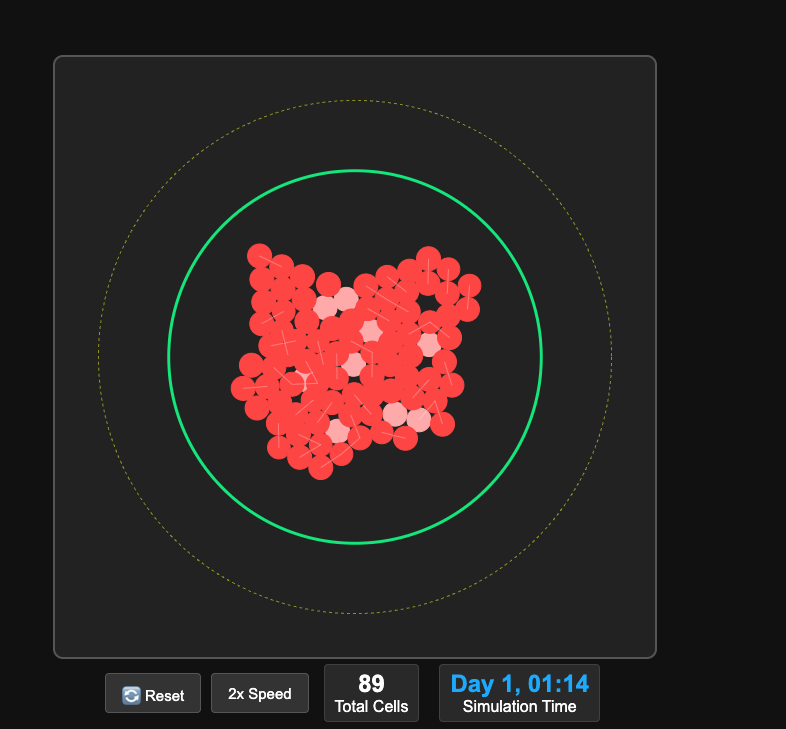
This interactive simulation demonstrates how tumors maintain their cell populations through cycles of stem cell activation and clonal expansion. The process of clonal succession allows tumors to persist despite individual cell populations having limited lifespans.
Main Simulation
Experience the full clonal succession simulation with interactive controls and visualizations:
Key Concepts
Clonal Succession
The process by which different stem cell clones take turns dominating the cell population, ensuring long-term tumor survival despite limited individual clone lifespans.
Stem Cell Activation
Stem cells transition from dormant to active states when suppression signals weaken, allowing them to divide and produce new cells.
Cell Lifecycle
Cells progress through distinct states: dividing, non-dividing, senescent, and eventually death, with each state having unique behaviors.
Population Homeostasis
The tumor maintains a relatively stable cell count through balanced cell creation and death, despite constant turnover of individual cells.
Test Pages & Examples
Explore different aspects of the simulation through these specialized test pages:
Documentation
Learn more about the biological basis and technical implementation of the simulation: